Insite Magazine
Prison Ministry: Saving Souls on Death Row
by Jennifer Jenkins

Chaplain James "Jim" Brazzil's round, smooth face reflects the spiritual peace of a man whose life dream has been fulfilled through his devotion to ministry. It's also a face that can fill with emotion. When he speaks of the inmates on death row to whom he has brought the acceptance of Jesus Christ as their personal savior, a wide smile of joy cuts across his face. It is replaced with sorrow when he thinks about their deaths.
By his own calculation, Brazzil says as many as 75 percent to 80 percent of the inmates he counsels accept Christ during incarceration, and the conversion is especially high among repeat offenders. From a violent, angry 19-year-old homosexual who murdered a preacher and his wife, to a 60-year-old, four-time offender who spent the majority of his life in prison, Brazzil's ministry changed each of their lives. He says, "Often it's at this point they realize there's nothing left for them. They've lost everything. They no longer have control of their lives or any contact with the outside world. They begin to realize a major change in their lifestyle is necessary."
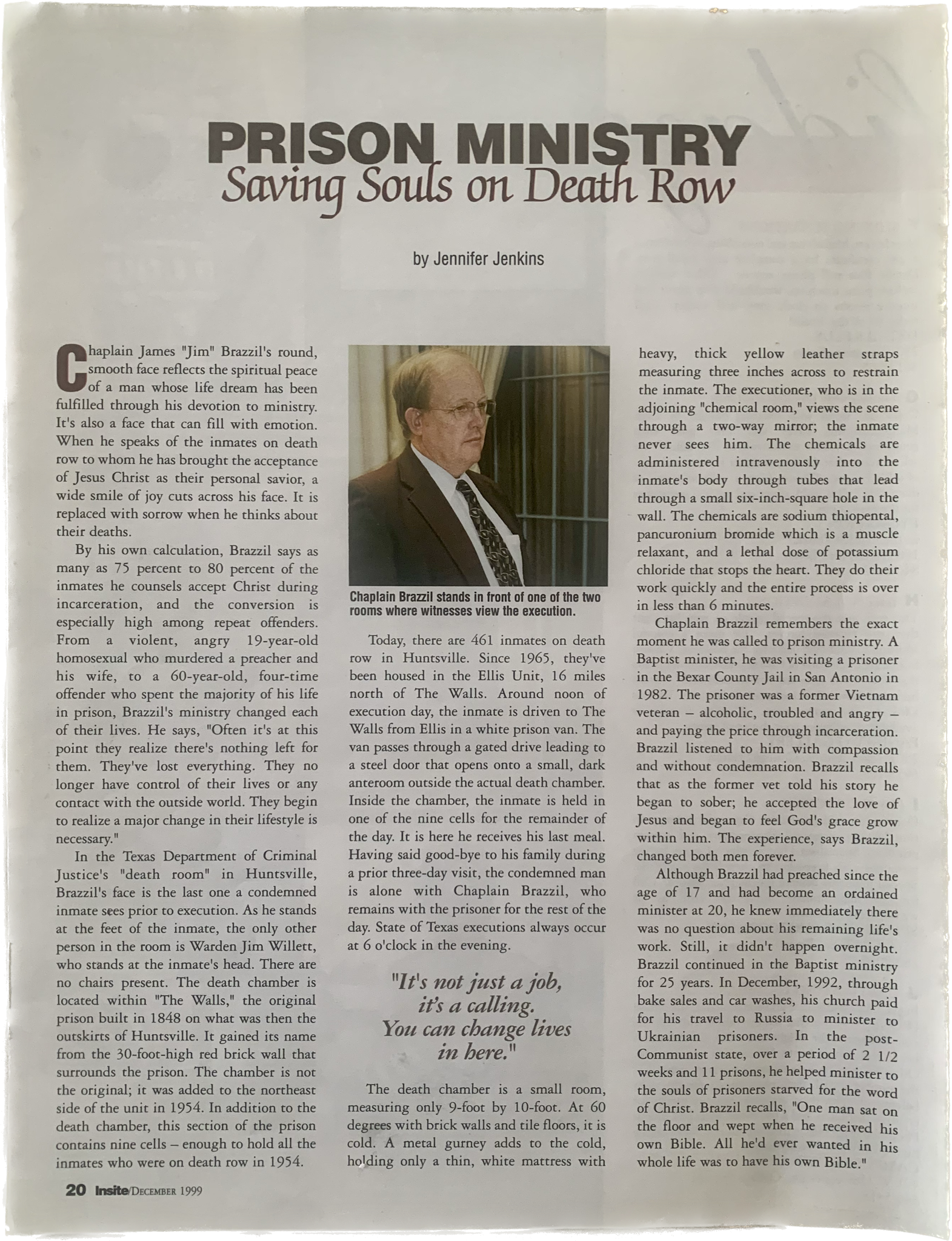
In the Texas Department of Criminal Justice's "death room" in Huntsville, Brazzil's face is the last one a condemned inmate sees prior to execution. As he stands at the feet of the inmate, the only other person in the room is Warden Jim Willett, who stands at the inmate's head. There are no chairs present. The death chamber is located within "The Walls," the original prison built in 1848 on what was then the outskirts of Huntsville. It gained its name from the 30-foot-high red brick wall that surrounds the prison. The chamber is not the original; it was added to the northeast side of the unit in 1954. In addition to the death chamber, this section of the prison contains nine cells - enough to hold all the inmates who were on death row in 1954.
Today, there are 461 inmates on death row in Huntsville. Since 1965, they've been housed in the Ellis Unit, 16 miles north of The Walls. Around noon of execution day, the inmate is driven to The Walls from Ellis in a white prison van. The van passes through a gated drive leading to a steel door that opens onto a small, dark anteroom outside the actual death chamber. Inside the chamber, the inmate is held in one of the nine cells for the remainder of the day. It is here he receives his last meal. Having said good-bye to his family during a prior three-day visit, the condemned man is alone with Chaplain Brazzil, who remains with the prisoner for the rest of the day. State of Texas executions always occur at 6 o'clock in the evening.
"It's not just a job, it's a calling. You can change lives in here."
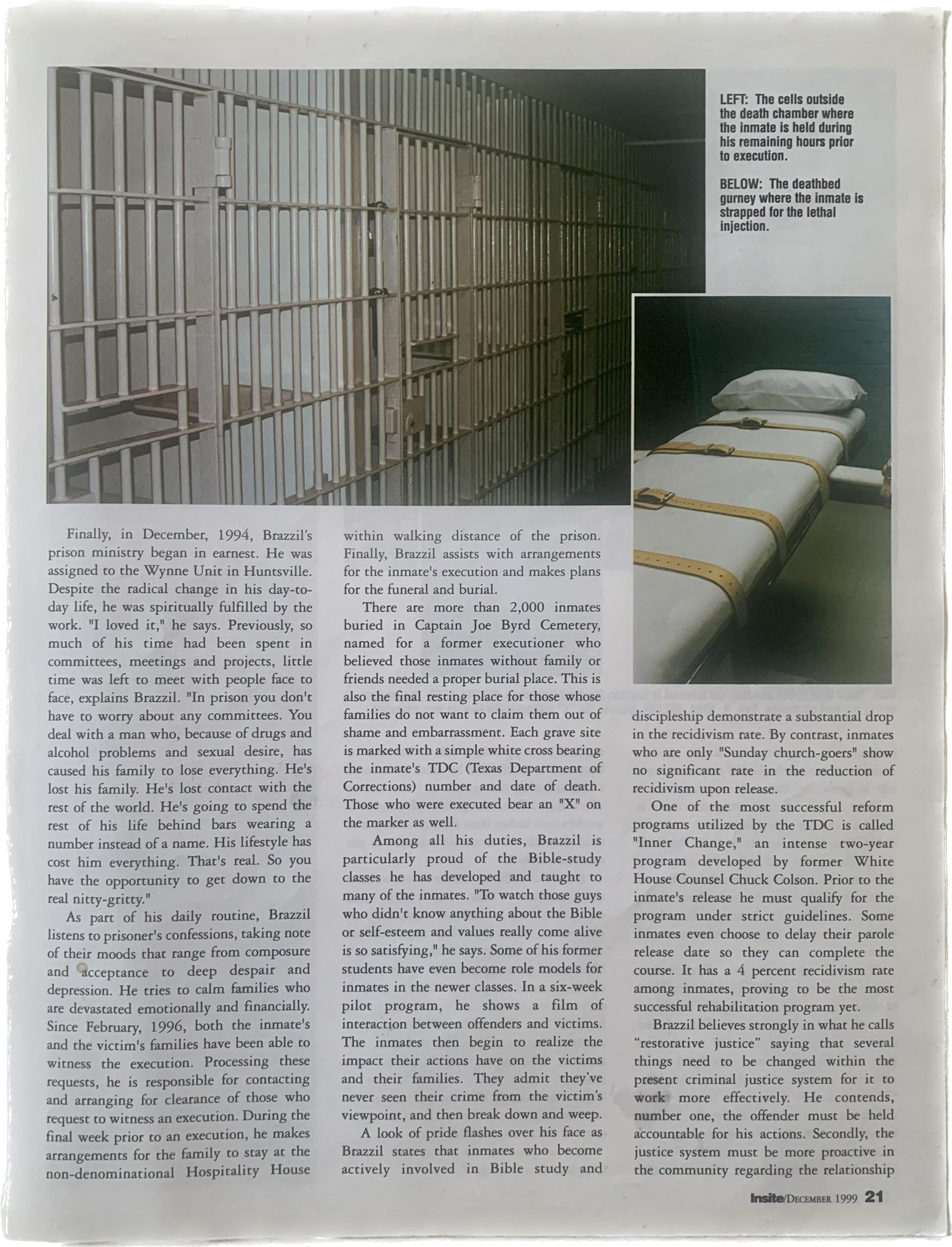
The death chamber is a small room, measuring only 9-foot by 10-foot. At 60 degrees with brick walls and tile floors, it is cold. A metal gurney adds to the cold, holding only a thin, white mattress with heavy, thick yellow leather straps measuring three inches across to restrain the inmate. The executioner, who is in the adjoining "chemical room," views the scene through a two-way mirror; the inmate never sees him. The chemicals are administered intravenously into the inmate's body through tubes that lead through a small six-inch-square hole in the wall. The chemicals are sodium thiopental, pancuronium bromide which is a muscle relaxant, and a lethal dose of potassium chloride that stops the heart. They do their work quickly and the entire process is over in less than 6 minutes.
Chaplain Brazzil remembers the exact moment he was called to prison ministry. A Baptist minister, he was visiting a prisoner in the Bexar County Jail in San Antonio in 1982. The prisoner was a former Vietnam veteran alcoholic, troubled and angry and paying the price through incarceration. Brazzil listened to him with compassion and without condemnation. Brazzil recalls that as the former vet told his story he began to sober; he accepted the love of Jesus and began to feel God's grace grow within him. The experience, says Brazzil, changed both men forever.
Although Brazzil had preached since the age of 17 and had become an ordained minister at 20, he knew immediately there was no question about his remaining life's work. Still, it didn't happen overnight. Brazzil continued in the Baptist ministry for 25 years. In December, 1992, through bake sales and car washes, his church paid for his travel to Russia to minister to Ukrainian prisoners. In the post- Communist state, over a period of 2 1/2 weeks and 11 prisons, he helped minister to the souls of prisoners starved for the word of Christ. Brazzil recalls, "One man sat on the floor and wept when he received his own Bible. All he'd ever wanted in his whole life was to have his own Bible."
Finally, in December, 1994, Brazzil's prison ministry began in earnest. He was assigned to the Wynne Unit in Huntsville. Despite the radical change in his day-to- day life, he was spiritually fulfilled by the work. "I loved it," he says. Previously, so much of his time had been spent in committees, meetings and projects, little time was left to meet with people face to face, explains Brazzil. "In prison you don't have to worry about any committees. You deal with a man who, because of drugs and alcohol problems and sexual desire, has caused his family to lose everything. He's lost his family. He's lost contact with the rest of the world. He's going to spend the rest of his life behind bars wearing a number instead of a name. His lifestyle has cost him everything. That's real. So you have the opportunity to get down to the real nitty-gritty."
As part of his daily routine, Brazzil listens to prisoner's confessions, taking note of their moods that range from composure and acceptance to deep despair and depression. He tries to calm families who are devastated emotionally and financially. Since February, 1996, both the inmate's and the victim's families have been able to witness the execution. Processing these requests, he is responsible for contacting and arranging for clearance of those who request to witness an execution. During the final week prior to an execution, he makes arrangements for the family to stay at the non-denominational Hospitality Housewithin walking distance of the prison. Finally, Brazzil assists with arrangements for the inmate's execution and makes plans for the funeral and burial.
There are more than 2,000 inmates buried in Captain Joe Byrd Cemetery, named for a former executioner who believed those inmates without family or friends needed a proper burial place. This is also the final resting place for those whose families do not want to claim them out of shame and embarrassment. Each grave site is marked with a simple white cross bearing the inmate's TDC (Texas Department of Corrections) number and date of death. Those who were executed bear an "X" on the marker as well.
Among all his duties, Brazzil is particularly proud of the Bible-study classes he has developed and taught to many of the inmates. "To watch those guys who didn't know anything about the Bible or self-esteem and values really come alive is so satisfying," he says. Some of his former students have even become role models for inmates in the newer classes. In a six-week pilot program, he shows a film of interaction between offenders and victims. The inmates then begin to realize the impact their actions have on the victims and their families. They admit they've never seen their crime from the victim's viewpoint, and then break down and weep.
A look of pride flashes over his face as Brazzil states that inmates who become actively involved in Bible study and discipleship demonstrate a substantial drop in the recidivism rate. By contrast, inmates who are only "Sunday church-goers" show no significant rate in the reduction of recidivism upon release.
One of the most successful reform programs utilized by the TDC is called "Inner Change," an intense two-year program developed by former White House Counsel Chuck Colson. Prior to the inmate's release he must qualify for the program under strict guidelines. Some inmates even choose to delay their parole release date so they can complete the course. It has a 4 percent recidivism rate among inmates, proving to be the most successful rehabilitation program yet.
Brazzil believes strongly in what he calls "restorative justice" saying that several things need to be changed within the present criminal justice system for it to work more effectively. He contends, number one, the offender must be held accountable for his actions. Secondly, the justice system must be more proactive in the community regarding the relationship between the perpetrator and the victim. And last, the church should play a stronger role in prison reform.
Even as the inmates recognize there is no planning for the future but only for today, Brazzil also has learned it's the little things that count and to live his own life at day at a time. He tries to see only the good in others rather than the bad. Many of the inmates have been on death row for a long time from only eight months up to 24 years.
It's not an easy job. Brazzil has witnessed many tearful, painful deathbed confessions as well as joyful deathbed conversions to Christianity. One of the earlier executions he attended a violent man who had raped and murdered seven - was one of his most trying cases. "While I was in there with him, I felt I didn't want to be there," he recalls. "I knew something was bad wrong in me, so I excused myself and went outside. I asked God, 'What's happening?' Then I finally realized I was putting a wall up between us because I was offended by what he'd done. I was allowing the nature of his crime to affect me. I was seeing him through the world's eyes rather than through the eyes of God. It took me about 30 minutes to get my heart right."
His most difficult moments come from the inmates who are cold and remorse or unapproachable, without repentance. They take their anger out on their loved ones as well as the victim's family, and ultimately to their graves with no forgiveness or peace. When asked if death sentences offer real retribution in the form of one life taken in the name of another, Brazzil shrugs his shoulders and answers, "The healing and closure for both families the inmate's and the victim's - begin immediately after the execution. You can actually see it on their faces right outside the death chamber."
Just as you can see it on the face of Chaplain Jim Brazzil.